.png)
The Ancient Nordic Art of Food Preservation

There is a kind of handed down intelligence that doesn’t come from abundance, but from knowing how to make the precious harvest last.
In the Nordic countries, where winters are long and light is something you learn not to take for granted, food has never simply been about what is fresh or available right here and now. It has always been about what can be held onto, carried forward, stretched carefully into the darker months when the land gives less and asks us for more. It's a lesson I have been careful to notice and although I preserved, pickled and canned before I moved to Norway I have really embraced it since absorbing some of the Nordic knowledge of food preservation.
Before freezers became the norm in kitchens, and supermarkets made every season feel interchangeable, preservation wasn’t a preference, it was a necessity woven into every part of life. And even now, long after that necessity has faded for most people, the old ways still linger, not because they are required, but because they feel like something worth remembering and there is a joy and fulfillment in that. What could be more joyful than a pantry full of homemade presevres?

You see it most clearly in the quiet persistence of certain foods that define Nordic tables. Fish that has been dried by wind and time until it becomes almost translucent and intensely concentrated in flavour. Berries carefully simmered into jams that capture a Nordic summer in jars. Meat hung in cold air, salted, smoked, and slowly transformed into something that could endure months without decay stored in the familiar stabbur. Milk turned into cheese, butter preserved with salt, vegetables crammed into fermentation jars where time does its slow, invisible work.
Nothing about it was rushed.
Everything depended on patience, and on paying attention to conditions that could not be controlled, only used cleverly when they arrived.
Cold air, for example, was not something to endure but something to collaborate with. Winter became a kind of natural refrigerator, a gift of temperature that allowed food to be stored in ways that would be impossible in warmer climates (and dare I say it, we still use it now when the fridge is full!). People learned to read the seasons not only for planting and harvesting, but for preserving, knowing when the air would be dry enough for drying fish, when frost would hold steady enough for storage, when smoke would carry properly through wooden structures built for curing.

In coastal communities, fish became its own language of survival. Cod hung in long rows, swaying in salt air until it transformed into stockfish, one of the oldest preserved foods in the world. Nothing about it was accidental. It was the result of generations refining a process that relied as much on intuition as on technique. Even now, in some northern regions, you can still smell that faint mix of sea and wind and time when you walk past drying racks in early spring.
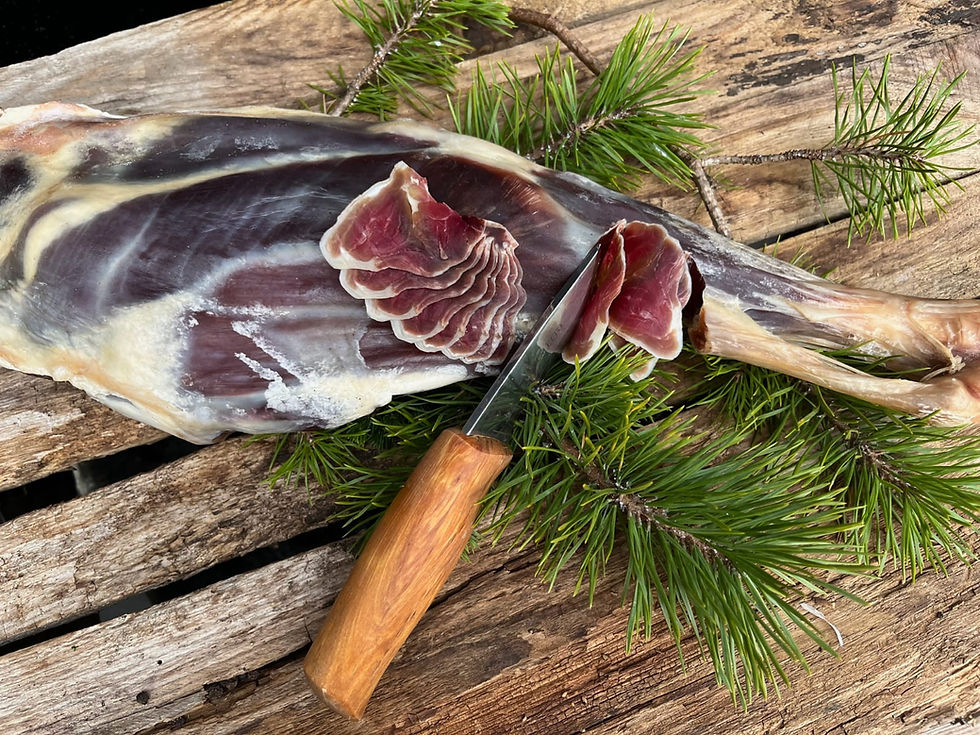
In inland areas, preservation leaned more heavily on berries, roots, and meat. The forests offered abundance in summer, but it was fleeting, and so everything was gathered, stored, and transformed with quiet urgency. Berries were boiled down into thick syrups or left in cold storage until winter turned them into a kind of frozen sweetness. Mushrooms were dried until they became fragile and aromatic, reawakening when soaked in water months later as if remembering themselves back into existence.

Fermentation, too, became an essential part of the Nordic kitchen long before it became a culinary trend elsewhere. Cabbage, fish, dairy, even grains, all could be changed slowly over time into something more stable, more complex, more enduring. It was not just about preservation, but transformation, an understanding that food could evolve rather than simply decay if treated with care and patience.
What is striking, looking back, is how deeply this shaped not just diet, but mindset. To preserve food was to accept uncertainty. It was to prepare for a future you could not fully see. It required trust in process rather than immediacy, in slow change rather than instant reward. In that sense, food preservation was never just practical, it was philosophical.
Even today, when most of us no longer depend on these methods to survive, there is something deeply satisfying about them that modern convenience hasn’t replaced. Perhaps it is the sense of continuity, the feeling that when you make jam or dry herbs or ferment vegetables, you are participating in something that has been done in nearly the same way for hundreds of years.
There is also a quieter comfort in it, in watching food change slowly under your care, knowing that time is doing most of the work and that your role is simply to provide the right conditions and then wait.
In a world that often feels fast, immediate, and disposable, these older methods offer something different. They remind us to slow down and to appreciate the length of time that food might take to produce. They reward patience rather than efficiency. And they remind us that survival, in its most basic form, has always depended on working with nature’s rhythms rather than against them. EVery item of food should be preckous and carefully prepared.

It is easy to think of food preservation as something ancient and distant, but in the Nordics it never fully disappeared. It simply softened into tradition, into taste, into habit. Jars still line kitchen shelves. Fish is still smoked. Berries are still gathered in summer and stored for winter. Not because they have to be, but because some knowledge feels too important to let go of entirely.
And perhaps that is the real legacy of it all. Not just the food itself, but the way of thinking behind it. That nothing good needs to be wasted and that time can be an ingredient. And that what we preserve, in the end, is not only food, but a relationship with the seasons that made it necessary in the first place.


Comments