.png)
Living With The Midnight Sun: When Evening Never Quite Arrives

By early July, much of Norway has settled into its summer rhythm. Schools have closed, cabins are open and filled with laughter, and conversations increasingly revolve around weather forecasts, swimming temperatures and whether the strawberries are worth buying Yet among all the familiar signs of a Nordic summer, there is one that remains quietly extraordinary. The light.
For visitors arriving from further south, the midnight sun can feel almost surreal. The first time you glance at the clock and discover it is nearly midnight, despite the sky looking more like late afternoon, is genuinely disorientating. Surely it cannot be that late. Surely there is still time for another walk, another coffee, another chapter of a book in the garden.
That, perhaps, is the great trick of the Nordic summer. It persuades us that there is always a little more day left.
Of course, not every part of Norway experiences the true midnight sun, where the sun remains above the horizon throughout the night. Yet even in the south, July brings remarkably long days and lingering evenings that seem reluctant to fade. Darkness becomes less of an event and more of a brief interruption between one day and the next. The effect on everyday life is surprisingly profound.

We all stay outside for longer. Kids cycle through neighbourhoods long after dinner. Outdoor cafés remain busy well into the evening. Walks that were intended to last twenty minutes somehow stretch into an hour. There is less urgency to rush home when the world outside still feels welcoming.
It is easy to see why Nordic people become slightly obsessed with summer light. After months of short winter days, there is a collective determination to make the most of it. Parks fill. Beaches fill. Ferry routes fill. Entire towns seem to migrate outdoors at the first opportunity. Yet the relationship with the midnight sun is not entirely straightforward.

For every idyllic evening spent sitting beside a fjord in golden light, there is also someone lying awake at one o'clock in the morning wondering why they are not remotely tired. Human beings, it turns out, are rather attached to darkness. For all our appreciation of long summer days, our bodies still rely on evening shadows to signal that rest is approaching.

Many newcomers to the Nordic countries discover this quickly (I was one!). The temptation is to treat every evening like a special occasion. Another walk. Another barbecue. Another swim. Another hour in the garden. Before long, bedtime has drifted later and later, and the accumulated effect begins to show. I frequently carried on gardening into the evening and then suddenly realised it was 11.30!
The sensible approach is not to resist the light entirely, but to work with it. Blackout curtains are remarkably popular for good reason. Bedtime routines become more important rather than less. Even the most enthusiastic summer lover eventually learns that exhaustion is not improved by a beautiful sunset at midnight. Perhaps this balance is one of the quieter lessons of Nordic summer living.
There is often an assumption that a good life is about squeezing as much as possible into every day. The endless daylight of July seems to encourage exactly this way of thinking. More activities. More plans. More experiences. More opportunities not to be wasted.
Yet the most contented people often seem to approach the season differently.
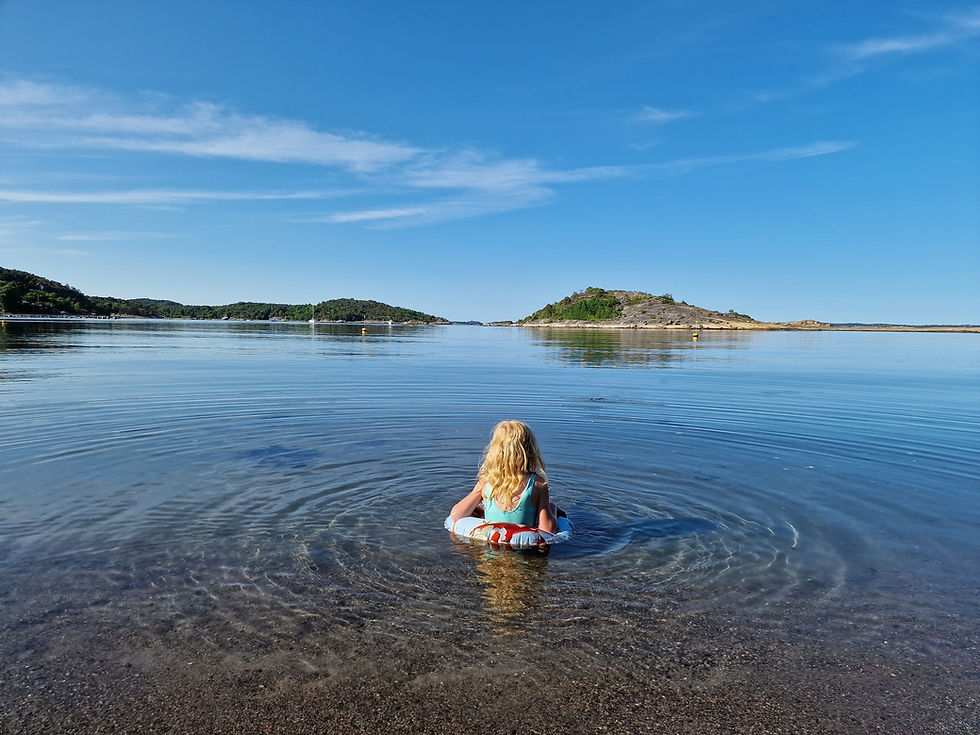
They sit on a balcony with a cup of coffee and do very little. They take a slow evening swim. They spend an hour pulling weeds from the garden. They watch the changing light across the water without feeling the need to document it. Rather than treating the long days as something to conquer, they simply allow themselves to enjoy them.
This may be why visitors often return from Scandinavia talking less about famous landmarks and more about atmosphere. They remember the evening light on painted wooden houses. The quiet roads at ten o'clock. The sight of families still gathered outdoors as though bedtime had been temporarily suspended.
The midnight sun is certainly beautiful, but its greatest gift may not be visual at all. It changes our relationship with time.
Without darkness drawing a clear line under the day, there is a feeling of spaciousness that can be difficult to find during the rest of the year. The hours seem less rigid. There is room for spontaneity. An ordinary Tuesday evening can suddenly contain a swim, a picnic or a walk through the woods simply because the light allows it. For a few short weeks, life feels slightly less hurried.
Perhaps that is why Nordic people become so protective of summer. They know how quickly it passes. By August, evenings will begin to darken. September will bring cooler mornings. Candles will quietly reappear on windowsills.
But in early July, there is still light stretching towards midnight and beyond. There is still the sense that the day is not quite finished. There is still time to sit outside for a little longer.
And if there is one thing the Nordic summer teaches us, it is that some of life's best moments happen when we stop rushing indoors and simply stay where the light is.
Enjoyed this article?
🌿 Continue Your Nordic Journey
If you're longing for a slower, gentler and more meaningful life inspired by the Nordic way of living, I'd love to invite you to take the next step.
Download my free guide
10 Simple Nordic Habits for a Slower, Gentler Life
Or, if you're ready to go a little deeper, explore the Living a Nordic Life Membership.


Comments